Three Versions of Rosencrantz and Guildenstern
Since I give quotation quizzes over the scenes from Hamlet that I’ve assigned for homework, one class began with a student asking, “Do we have to be able to distinguish between Thing 1 and Thing 2?” I laughed at the clever re-naming of Rosencrantz and Guildenstern using Dr. Seuss’ Cat in the Hat.
“No, no,” I said, “I would never ask you to differentiate between those two characters—especially since the characters of Hamlet themselves don’t seem to be able to tell them apart either.”
At least three times in the play, characters mix up the two “childhood friends” of the Prince. First, the King mixes them up while hiring them to spy on Hamlet (only to be gently corrected by Gertrude), then Hamlet doesn’t seem to know which is which when he first greets them (“How dost thou, Guildenstern. Ah, Rosencrantz. Good lads, how you do both?”), and finally when Hamlet wants to mock Polonius in front of the actors (“Hark you, Guildenstern; and you too; at each ear a hearer”). It’s only in Tom Stoppard’s Rosencrantz and Guildenstern are Dead that the two men seem to develop personalities: Rosencrantz being the “dumb, earthly” one (who belongs to the stone like Gogo in Godot does) and Guildenstern being the “smart, rational” one (who belongs to the tree like Didi). But even in that play Ros and Guil don’t seem to remember their names and often introduce each other wrong.
Over the course of teaching the play these last 27 years, I’ve watched many productions—and I’ve seen Ros and Guil (as I like to call them) portrayed in three main ways.
First, Ros and Gui are evil, false, spying, ulteriorly-motived “friends” who take payment from the King and Queen to “pluck out the heart of Hamlet’s mystery.” This evil version of the pair is definitely how Hamlet himself comes to see them by the end of Act 3. The two are set up to be foils to the true, supportive, loving friend we see in Horatio. In one image I particularly love in the 1996 Branagh film, we see Claudius walking through a door with two ominous shadows behind him—Ros and Guil in the King’s corner and in the king’s employ. This image is shown when Hamlet is imagining killing Claudius when Claudius is deep in evil so that his soul would be damned—to Hamlet, Claudius plotting with the evil Ros and Guil clearly qualifies for this distinction.
Second, Ros and Guil are comically stupid: Thing 1 and Thing 2; Tweedle-Dee and Tweedle-Dum; Dumb and Dumber. I was lucky enough to see a five-actor version of Hamlet starring 4 men and 1 woman by the Bedlam Acting Company. In this production, Ros and Guil were morons. They affected mush-mouthed California surfing accents and sat like dumb apes for most of their scenes. The reasons for doing so? One: cheap comic relief (which isn’t really a bad thing in a giant, gruesome tragedy). Two: to explain why Ros and Guil are so bad at their hired job (interviewing Hamlet). After all, Ros and Guil lamely confess, “My lord, we were sent for” almost immediately upon Hamlet’s questioning. They are Boris and Natasha from Bullwinkle, the worst spies ever.
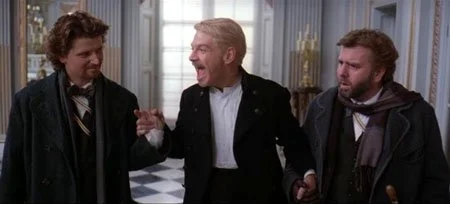
But the third reading is the one I like best—mostly inspired by Branagh. In the third version of Ros and Guil, they are neither evil nor stupid. They are decent young men forced into an uncomfortable position, unaware of the dangerous whirlpool they are being pulled into. They aren’t bad spies who confess their spying too easily; they are reluctant investigators forced by a King and Queen to obey. They don’t understand Hamlet most of the time, and they don’t like interacting with him under false pretences. Hamlet’s bizarre behavior and dialogue only convinces them that something is well and truly wrong with the prince and thus, out of obedience to the King and out of some lingering friendship from childhood or early college days (Ros and Guil were apparently fraternity brothers of Hamlet at Wittenburg), they keep pursuing the prince—to help both him and the King and Queen and the future of Denmark. The fact that they are villainized by Hamlet for their efforts and then dispatched with no regrets from Hamlet (“They come not near my conscience”) makes their fate all the more tragic and horrific.
In Branagh’s 1996 film, Reece Dinsdale and Timothy Spall do a superb job playing Ros and Guil (or Guil and Ros, ahem) in this sympathetic way. They honestly seem like well-meaning men who are eager to be both helpful to the King and Queen and Hamlet himself. They mostly look confused throughout their scenes—as well as frustrated and a little frightened. Their timidity though evokes no mercy from the often cruel prince.
In my class, I’ve found that showing students how “bouncy” Shakespeare (that is, how differently the same lines or character can be portrayed from production to production) is what can make Shakespeare exciting to them. They see that the plays are not static works of art, like a painting in a museum, that looks the same every time. The way any character or any line can be altered according to the actor, director, or producer’s vision is one of the reasons Shakespeare is marvelous to study and watch (and one of the reasons that the Bard just will not go away). In the right hands, his plays are fresh every single time.
Plus, I just love an “interpretive problem” that we (or actors and directors have to solve). Why do Ros and Guil confess to being “sent for” so quickly in Hamlet? Well, there could be many explanations for that . . . I call Hamlet “a play of problems” for a reason—a new one crops up in almost every discussion.