O, Reason Not the Need!
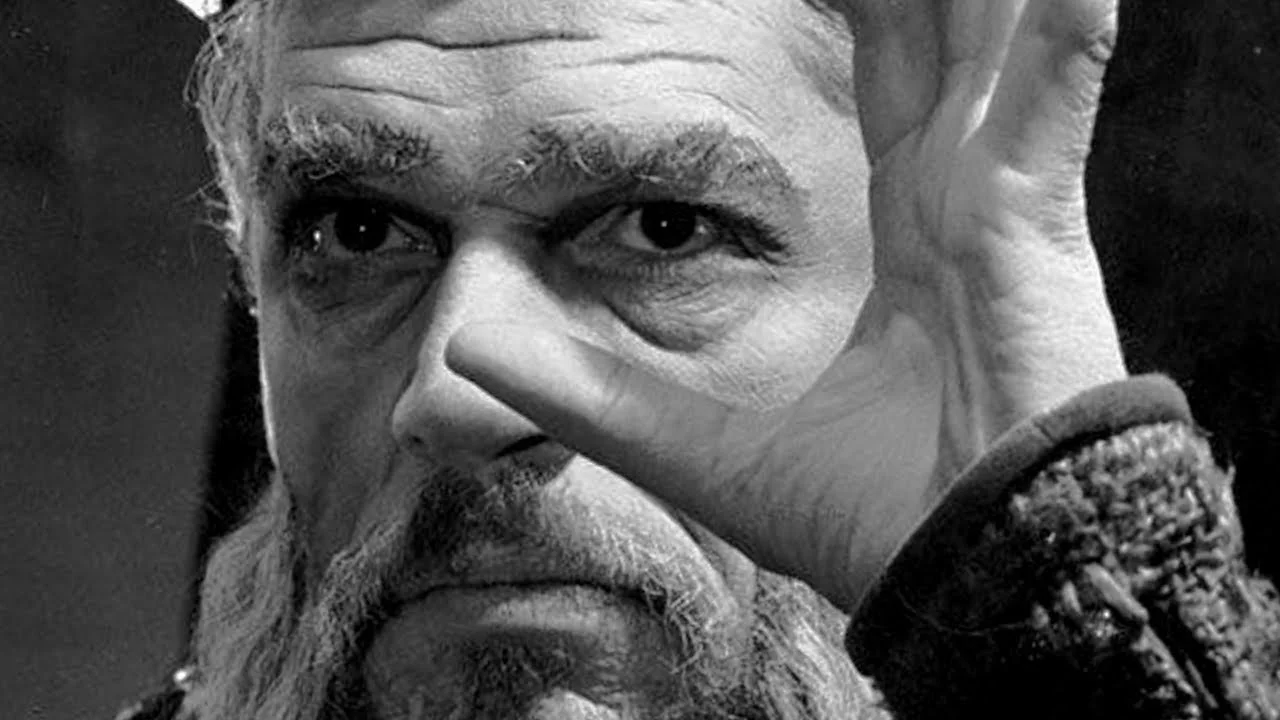
Traditionally, the scene is the vicious stripping away of dignity from King Lear by his two evil daughters. Goneril and Regan—standing on either side of their reverend father—gleefully mock his irrationality in wanting them to house, feed, and pay 100 knights when he stays at either of their homes. The poor old man runs between them, desperately trying to figure out which daughter will let him keep more knights—still trying, even after the disaster of Act 1, scene 1—to quantify their love and respect.
It isn’t a pretty scene, for sure—maybe even comical watching Lear scramble from side to side—but (hear me out), Goneril and Regan are correct. Lear’s demand to care for 100 knights is beyond ridiculous—especially since his knights are riotous and turn every house (as Goneril puts it) into a tavern or brothel.
I get it though. King Lear is old (“age is unnecessary”). He’s at the time of life where his job (since he gave up his Kingly job) is “manage his decline.”
No one—especially no man—wants to do this. I don’t want to do this, and I’m still thirty years away from Lear’s four-score. Men are raised to be strong, to provide, to be depended upon. When the tables turn, and a man has to depend on someone else? Well, no wonder they get so bitter, sad, and grumpy. Their youth, to quote Blanch DuBois, has “gone up the waterspout” and they can no longer “turn the trick.” Men do all sorts of things in reaction to this unpleasant “change of life” (to quote Janie Crawford).
I mean, Lear could’ve married another wife—no doubt, a much younger one who could help him maintain the illusion of his power and virility. I shudder to think what would have happened to such a wife with Goneril and Regan as step-daughters anxious to claim their patrimony. Instead, Lear hangs out with young men. He loves his rambunctious knights. Their loud rowdy youthful masculinity makes him feel as if his maleness hasn’t paled. And, of course, they worship Lear and do whatever he asks without hesitation—making him feel respected and still effectual.
No one else enjoys them though, excepting Kent and the Fool.
Still, the scene is not pretty to see. It reminds me a bit of Ishmael in Moby Dick describing how he is hesitant to describe what happened to Starbuck on the Pequod because it is shameful to see the “valor of an undraped man.”
And yet . . . and yet . . .
The sisters tag-team Lear (reminding me of Rosencrantz and Guildenstern ever at either side of Hamlet’s ears):
GONERIL
Hear me, my lord;
What need you five and twenty, ten, or five,
To follow in a house where twice so many
Have a command to tend you?
REGAN
What need one?
The ladies have their point. They assure Lear that they and their servants are perfectly capable of handling all Lear’s wants and needs. And their points multiply: How can one house run well if there are two masters within it? If we sisters were in charge of your servants, we could punish them if their services fall slack. Honestly, they are just assuming authority which Lear had foolishly given to them anyway one act ago.
At this point, I must insist that you go hear my favorite Shakespearean actor, Paul Scofield, in the recording he did of King Lear for Naxos in 2001 to mark his 80th birthday. It’s my very favorite version of the play though it is just an audio performance.
Scofield, famous for his rich baritone, simply eats this role up. Maybe it’s his greatest. The Naxos performance, strangely, is totally different from the movie version of Lear he played directed by Peter Brooks (which is almost unbearable to watch). In that version, Scofield plays Lear as a heartless tyrant. There is no hope or redemption or even humanity in that king. Clearly, Scofield obeyed his absurdist director, but he had a different Lear in his heart. That Lear is present in 2001.
After Regan snidely comments, “What need one?” You hear Scofield, struck to the heart, cry out: “O, reason not the need!” (followed by a loud thunderclap—so well done). In fact, Scofield stretches out the word “need” to be almost four syllables! “O, reason not the ne-ee-ee-eed!”
To quote Gloucester (later): “And that’s true too.”
For King Lear has a point as well.
Yes, his 100 knight demand is ridiculous. We can understand why he feels like he needs to have his knights, but it’s an unwieldy and heavy demand.
STILL, Lear—who is starting to realize that he’s just a man and not a god—claims that “our basest beggars / Are in the poorest thing superfluous: / Allow not nature more than nature needs, / Man's life's as cheap as beast's.”
To me, this is where the play really starts cooking. This is where Lear really starts to get interesting. Yes, it’s the story of a family and its issues, but somehow Shakespeare makes it about so much more: about what it means to be a human being itself. Strangely, Lear doesn’t just learn about his personal problems, his suffering makes him a sort of conduit for speaking on EVERYONE’S PROBLEMS, the problem of being alive in an often cruel and unjust world that no God or gods seems to be watching over.
What Lear seems to zero in on here is that being a human means to have dignity. His daughters are stripping him of that dignity and making him and his life “as cheap as beast’s.” Dignity, or inalienable human rights, seems (to me in my understanding of Kant and Nietzsche) an irrational belief. It cannot be reasoned out; it simply must be assented to, believed.
No one, Lear says, not even “our basest beggars” live simply according to need. No toddler needsa toy to cling to—and yet they do so (and we happily help them have something to hold). We aren’t animals born to just (quoting Hamlet) “sleep and feed, no more.” We are something more, and we are made for something more—and I guess there’s no better word for that than the irrational belief in human dignity.
As a Christian, I am not troubled by this belief’s irrationality. I believe human beings all have dignity because they are made by God and in the image of God, but I can see it being troublesome to others since it makes no sense.
Goneril and Regan are not wrong—Lear does not need 100 knights—but they aren’t right either to think their father needs nothing but their care. He needs to feel like he’s still a man. He needs to feel like he matters, is of some significance. He is a fool (as the Fool rightly calls him out 1000 times) because Lear destroyed himself when he divided his kingdom and gave up his authority. He gets, as they say, what he deserves—or at least the karmic consequences of his act come home to his head.
It’s just horrible to watch it happen because a fool is to be pitied. And a man stripped of his dignity is something tragic to behold. And the play is thrilling to me because at the same time that Lear is losing his manhood and dignity, he is realizing truly what it is to be human and to be a man. And so am I.