Read and Write with Intelligent Feedback
One of my principals over the course of my teaching career was really into “book studies.” Every department had a different book we were to study and discuss over the course of the year. My English department decided to read Focus by Mike Schmoker.
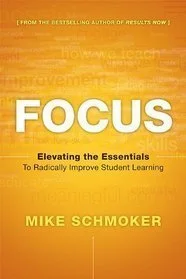
The book (which is great, by the way) is sort of a covert attack on Reading Standards and Objectives—not because the standards and objectives are bad per se--but because they are unhelpful, mind-numbingly boring, and more often used in isolation as a cudgel to torture teachers who are writing lesson plans and the poor students who are experiencing them.
Although our principal didn’t intend to change our perception of “teaching English,” he definitely did. After reading Schmoker, I felt a fog in my vision lift, and I found my core “teaching English philosophy or pedagogy” which is quite simply this statement:
All students need to do in an English class is “read, write, and speak with intelligent feedback.”
This statement isn’t totally comprehensive or definitive, but it’s a good start. I mean, yes—students need to be taught grammar explicitly. Yes, students need to be taught “test prep” for ACT, AP, or IB testing. And yes, students need to be taught how to do research and (God help us) MLA format. And maybe—depending on where and who you are—students need to be taught about their literary heritage (as my English teacher patron saint, Blanche DuBois) puts it.
But, ultimately, students just need to read, write, and speak with intelligent feedback. While I take my content area very seriously, I honestly think that mostly what the English classroom should be about is fun. Or joy. And you can’t have fun or feel joy when you are explicitly “mastering a standard or objective.” I mean, you may be able to have fun if you are mastering standard covertly—but overt approaches tend to be dead ends.
As my mentor teacher once mournfully said to me when I was an intern: “The more I teach them about commas, the worse they get at commas”—a statement that still makes me howl with laughter at the madness of attempting to teach anyone anything at all.
The English classroom—in a slightly different way than math or science classrooms—is a community. One of the best teachers I’ve ever known told me that the pedagogy that has never been surpassed or improved upon is simply “Socrates talking to three or four dudes in a circle.” I think that’s true.
The English classroom is about jabber-jawing about some text and the issues found within that text. “Jabber-jawing”—to a STEM teacher—looks like a waste of time. But it is profoundly not. Discussion is, to me, the most important thing that happens in the English classroom.
Teaching the skills, the standards, the objectives covertly is what the English classroom should be all about. That doesn’t mean “never be explicit” or “never skill-and-drill” or “never do a worksheet or lecture”—but those activities should never be the center of the English classroom, or we’re all going to die of boredom.
Whenever I get lost in my classroom, whenever I lose my belief that what I do matters, whenever I’m confused about what I’m doing, I come back to Schmoker’s words and remind myself of what students (and myself) need to be doing:
The students just need to read cool texts, talk about them, write about them—and get intelligent feedback from me. A tennis match. A bouncy ball. Back and forth, back and forth . . . ad infinitum.