Quixotic
My first year teaching, I had a little Word-of-the-Day calendar on my “teacher-desk.” I guess I thought it made me look very English-teachery indeed.
I kept some of the little tear-off word sheets that were important to me and lost most of them over years, but one word stayed with me: quixotic.
According to my little calendar page (and the Merriam-Webster Dictionary), “quixotic” is an adjective meaning “foolishly impractical, especially in the pursuit of ideals.”
The word, of course, is an eponym. It derives from Miguel Cervantes’ iconic character Don Quixote.
Don Quixote is one of my many Patron Saints of the English Teacher.
I first knew Don Quixotie as “the Man of La Mancha”—I remember when I was a child sitting in my dad’s lap watching Masterpiece Theater on PBS watching the musical. I didn’t understand much of it, but I could tell it was funny (Don Quixote insisting that a common shaving bowl was the Golden Helmet of Mambrino and basically just confusing everyone around him). The music was powerful and moving to me. Since it was a “bare bones” production, I also got my first taste of theater magic when Cervantes magically turned himself into Don Quixote in an instant make-up beard transformation and rode a fake horse made up of a couple of two by fours.
I specifically remember (though it’s all blurry) the end of the play. The signature song of the production is “The Impossible Dream”—and it is reprised in the finale. My dad helped me understand that Don Quixote was really Miguel Cervantes and that Cervantes was telling the story to entertain other prisoners in jail while they awaited judgement from the Spanish Inquisition. I could feel some element of threat or darkness behind the funny tale. It probably helps that I was raised Southern Baptist and had the terror of divine judgement placed in me early in life.
At the end, Don Quixote dies, and a sort of plank lowered for Cervantes to walk up to face the Inquisition and its judgment on him. The inmates (who all similarly transformed into characters from the story) sang “The Impossible Dream” as Cervantes slowly and bravely walked up the plank. I guess it was my first experience of a tragic and noble story outside of church.
Anyway. I always identified with Don Quixote because he was a Dreamer, a Romantic. (It also helped that he was skinny and goofy like me).
I sometimes would mention my affinities with the Man from the La Mancha to students over the years, and one year a student (who had been to Toledo, Spain) brought me back this beautiful tile.
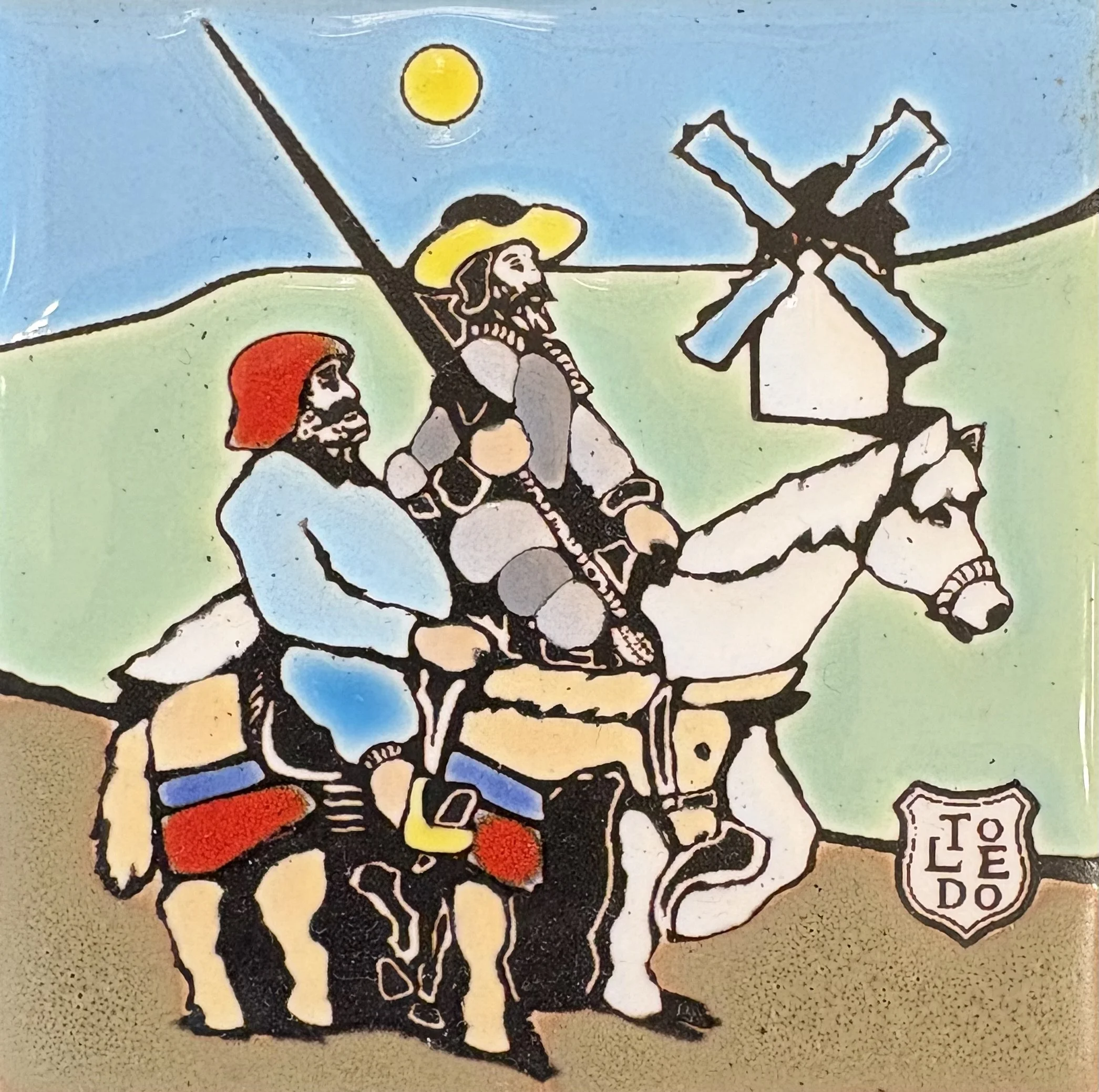
The tile has become an icon of my classroom and teaching practice.
But what, you might ask, does Don Quixote—a chivalrous knight—have to do with being a teacher.
Well, as I sometimes tell my interns, to be a teacher you have to be a little delusional (like the good old man). You have to believe that next year is going to be great. You have to believe that you’ll have an even better classroom, syllabus, and curriculum than the year before. You have to believe that the kids are more than alright and are going to make the world a better place and find happiness and purpose for themselves. You have to dream the impossible dream because (as I’ve said in other places) teaching is mostly failing.
So, I believe, that as a teacher you have to be idealistic (or “delusional”) but you also have to be very practical and grounded. Thus enters Sancho Panza.
If Don Quixote is crazy and idealistic, his delightful squire is there to keep him safe and on track.
In my mind, Don Quixote represents the dream of the perfect classroom and the best teaching practice—while Sancho Panza represents the reality of school: the nuts-and-bolts of counting up days and typing up syllabi, of making lesson plans that fit within 96 minutes and help prepare students for my curricular goals. Sancho is also all the duties a teacher has, all the grading, and e-mails, and extra-curriculars and empty bank account.
Every year, I dream the Impossible Dream while Sancho Panza pulls at my shirtsleeve. Both men, both impulses in my life seem symbiotically necessary for me to keep going each year.
As Proverbs says, “Without a vision, the people perish.” Without a dream, the teacher can’t teach.
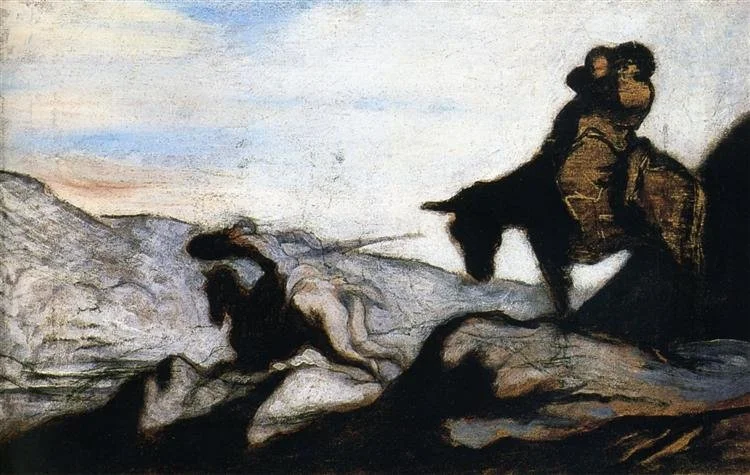
P.S. I also love this Daumier image of the Man of La Mancha (tilting at windmills, of course) agonized over by a heartsick Sancho Panza. What to do? What to do with such a man?