Kafka: Is Gregor Samsa a tragic figure?
One topic that has fascinated me for my entire teaching career is the nature of tragedy. I feel a strong gravitational pull toward the genre, and I’m not sure why. Is it because I have a morbid, depressive streak within me? Is it because of my fundamentalist Southern Baptist upbringing that emphasized sin being everyone’s natural state? Is it because America is a “death-forgetting” culture, and my contrarian nature wants to be told “the truth” that most media and day-to-day life hides?[1] Is it simply because comedies lack depth and thus tragedies are “better to talk about?”[2] Or am I just Aristotelian and get a thrill of “pity and fear” when I read or watch a tragedy?
The idea of “tragedy,” of course, the “goat drama,” is a huge one—and when we call something a tragedy, we may mean different things based on the time period the tragedy was written. The ancient Greek tragedies (where it begins Western literature) are different than Shakespeare’s tragedies—which are different from later American tragedies.[3] And I think tragedies onstage are different than tragedies in novels as well. The nature of tragedy also depends on gender as well: Anna Karenina’s tragedy is different than Willy Loman’s.
One formula I’ve developed over the years is that a tragic protagonist has to be at least 50% victim of his of his or her circumstances and 50% victim of his or her own choices. I think I came up with this idea when I studied Arthur Miller’s Death of a Salesman in graduate school (and then taught it for the next fifteen years).
One critic of Salesman mentioned that Willy Loman could not be a truly tragic figure because he was just a victim of capitalism. Watching Willy’s decline and fall was undeniably affecting, the critic went on, but only in the same way that “watching a dog get run over” was emotionally disturbing: neither Willy nor the dog were tragic.[4] They were more pathetic—meaning “evoking emotion in the viewer,” not “pitiable, weak, and disgusting” (which is what my students mean when they say “pathetic”).
I guess I really wanted Willy to be tragic because I pushed back on seeing Willy as entirely a victim of capitalism. The play became less interesting to me (and to Miller, apparently) if that’s all Salesman was.
If the play were indeed just that reading then I wondered “Why the adultery plot?” Capitalism did not make Willy cheat on Linda. Willy chose to cheat on Linda (out of weakness, out of loneliness—I’ve never been quite sure why he cheats on his wonderful, loving, supportive, and amazing wife). To me, Willy is partly responsible for his downfall. And I guess the Raised-Baptist side of me wants him to pay for it.[5]
Which brings me to Kafka’s The Metamorphosis.
I resisted teaching this work for years because A) I did not know what I would say about it, B) I did not think it would lead to good discussion, and C) it just seemed too short, too weird—and I honestly never really liked what other people said about it.
But for some reason—honestly, it probably “fit” a certain amount of days I needed to fill—I started teaching it. And I ran into the problem of tragedy all over again.
Kafka’s book is not ambiguous about Gregor’s victimhood. Gregor is 100% victim of his transformation[6]. He did nothing to cause it, and he has no power to change it. Indeed, from sentence two, he accepts what happens to him with (almost) comical equanimity. The great Kafka joke being that “Gregor cares more about getting out of bed and getting to work on time than he does about the fact that he is now a giant beetle.”[7]
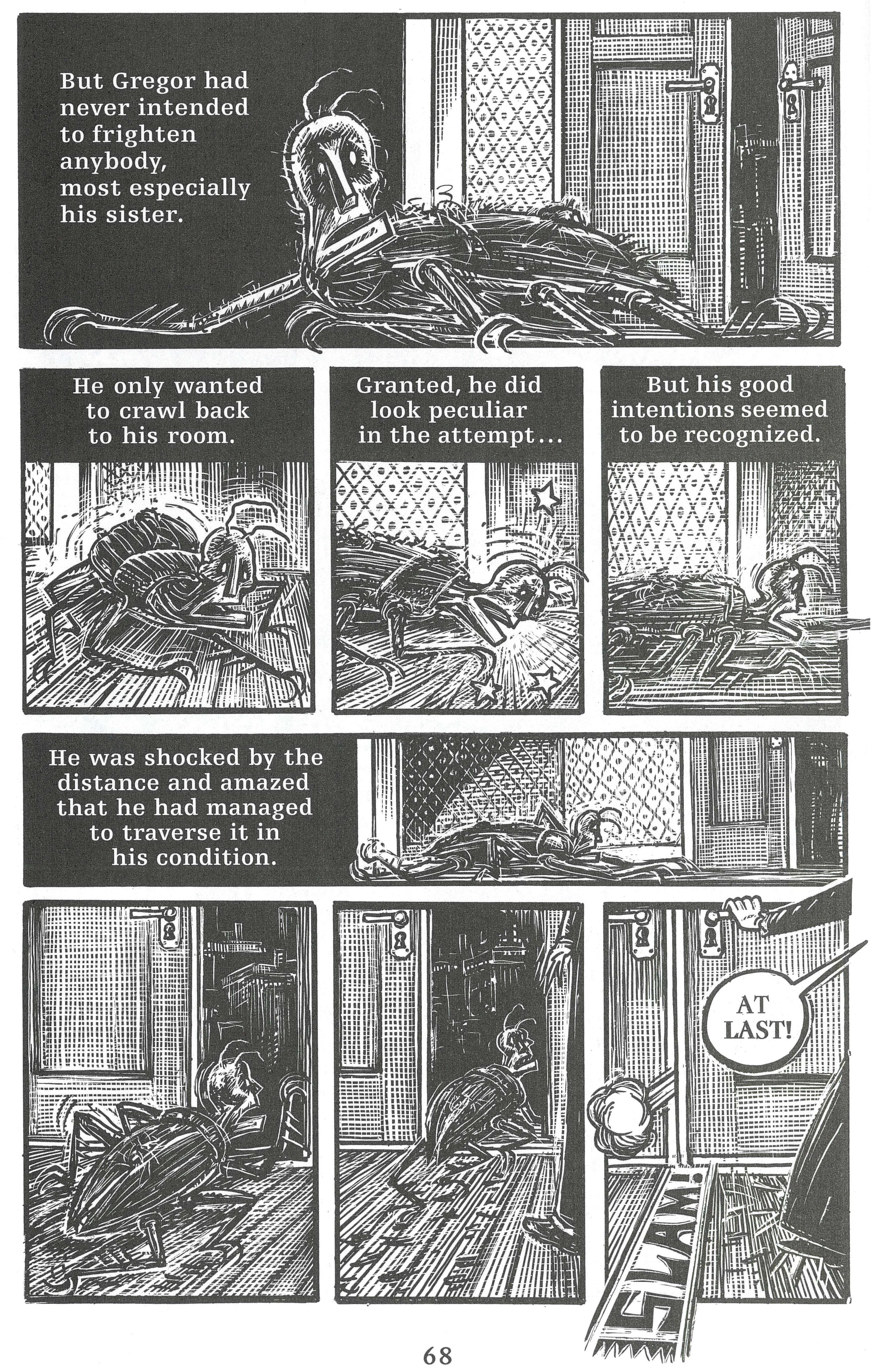
From Peter Kuper’s amazing Metamorphosis Adaptation
The book is a nightmare—and, regardless of David Foster Wallace’s insistence that Kafka is comic, the book isn’t that funny at all. We watch Gregor endure his bugness with a saint’s patience. We are both glad when Gregor starts to feel at home in his body—and then horrified because it’s an insectoid body and he’s losing his humanity. Even the first scene is just pure body horror (and yes, somewhat comic): Gregor wakes up on his back, helpless, and sees his six little legs squiggling all about without his intention or volition. The tiny book is filled with these awful moments: Gregor’s body does something without his consent or intention.[8]
The ultimate example of Gregor’s body doing things without Gregor intending to do these things is in the great death scene. After Gregor has horrified everyone by leaving his bedroom and coming into the living room to listen to Grete’s violin-playing, he crawls back to his room by putting his head to the floor (because most of his legs aren’t working anymore) and pulls himself inch-by-inch into the room.[9]
Once in his room, Gregor just lays there, completely spent. He had just heard his sister claim that the bug is not their brother and son. “If that bug were Gregor,” Grete claims, “He would have gone away on his own and not tortured and burdened us so.” Gregor has gone from “thou” to “it” in Grete’s eyes.
Gregor is a beautiful soul, but filled with shame. He hates himself for being a burden to his family after once being their sole source of financial support. But, horribly, Gregor doesn’t even have power of his own life. He cannot kill himself. He cannot do almost anything. So Kafka has some mercy on his poor character by having his bug body kill him.
The mysterious line Kafka wrote claims that as the clock struck three, Gregor’s head “of its own accord” or “without his consent” fell to the floor and his last breath left his nostrils.[10]
As I studied that line, I felt more and more horror. Gregor’s bug-body killed him without Gregor’s consent. I admired the line because—if nothing else—Kafka was consistent in his body horror. As the critics say (giving me shivers), “The metamorphosis was not complete.” It never was—not even at the end. Gregor was always “Gregor inside the Bug.” If the metamorphosis were complete, Gregor would just be a bug with no human thought or identity whatsoever. Kafka isn’t going to give us that peace.
It wasn’t until days later that I started to think that Gregor’s bug-body assassination isn’t actually that weird because isn’t that what happens to most of us? Some people choose to end their lives, but most of us have our life ended. Our bodies weaken, decay, and betray us. And I shivered all over again.
But here’s my question. What kind of protagonist (or hero) is Gregor? Is he tragic? Or is he merely pathetic?
To me, to be tragic means to have a dignity and nobility in your fall. I guess that’s why agnorosis is so important. The tragic figure has to see both their victimhood and their culpability. They have to know, at some level, “I did this—and I deserve this.”[11] Gregor has a sort of dignity, though, in his total victimhood. To quote my students, “He’s a victim—but without a victimhood mindset.”[12] It is true that Gregor is not filled with self-pity or angry blame at his parents or God.
It took several discussions of the novella for me to see that Gregor’s dragging himself into his bedroom after the violin scene resembles dogs and cats dragging themselves off to die (as they so often do). When we discuss animals dying, we might describe them scornfully as “dying like a dog” on one hand, and then, dying with dignity on the other. So many animals seem to know and accept their demise with something we humans see as dignified.
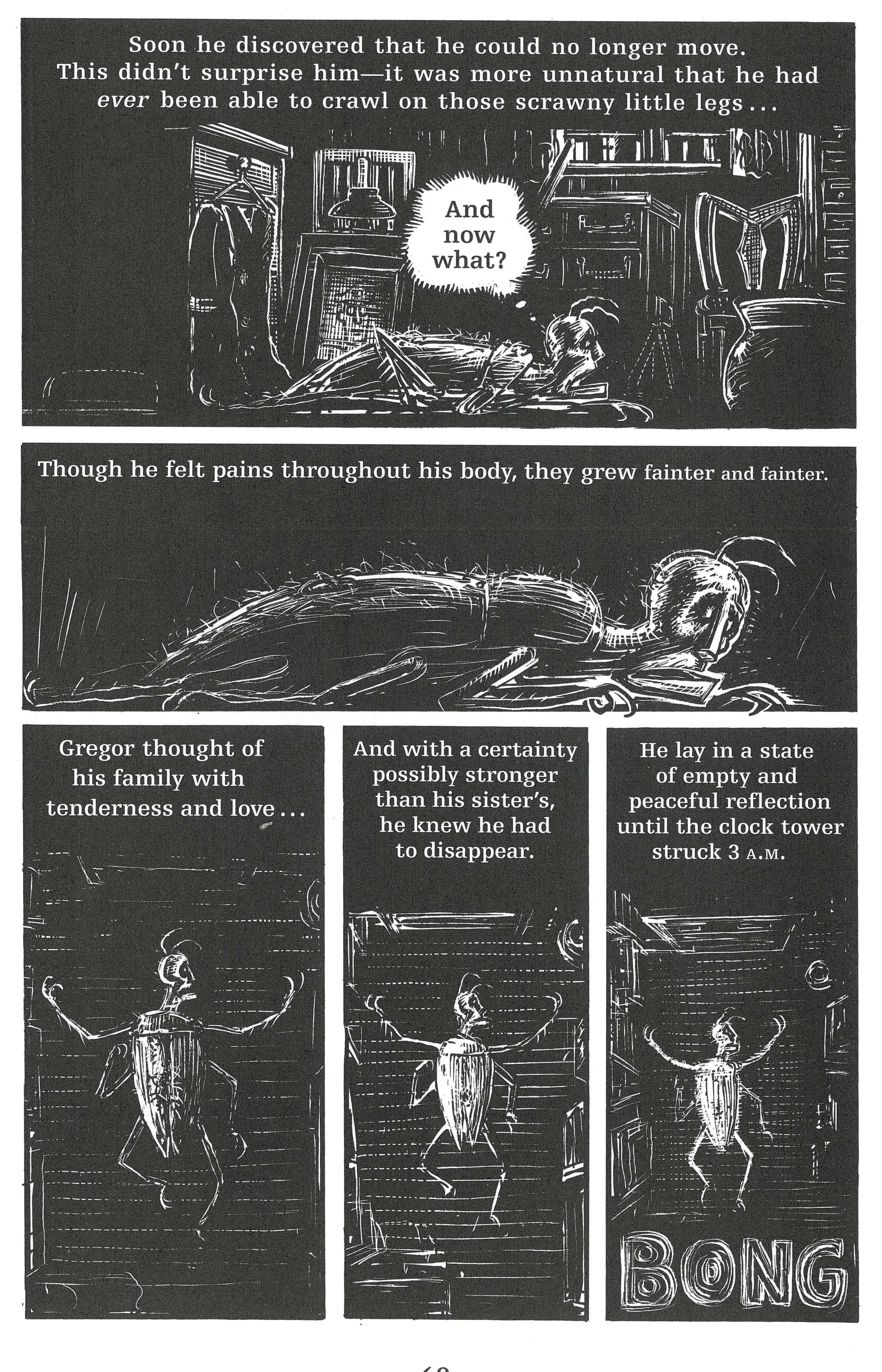
I have a comic book version of The Metamorphosis that definitely plays into the “noble, dignified” death reading of Gregor where his victimhood is seen as martyrdom. Gregor’s head-dragging retreat to his bedroom is shown over one long page in twelve panels—painful and slow. When he is finally in his room, Gregor is shown from above, cruciform style, with both bug legs stretched outward as if Gregor were Christ.[13]
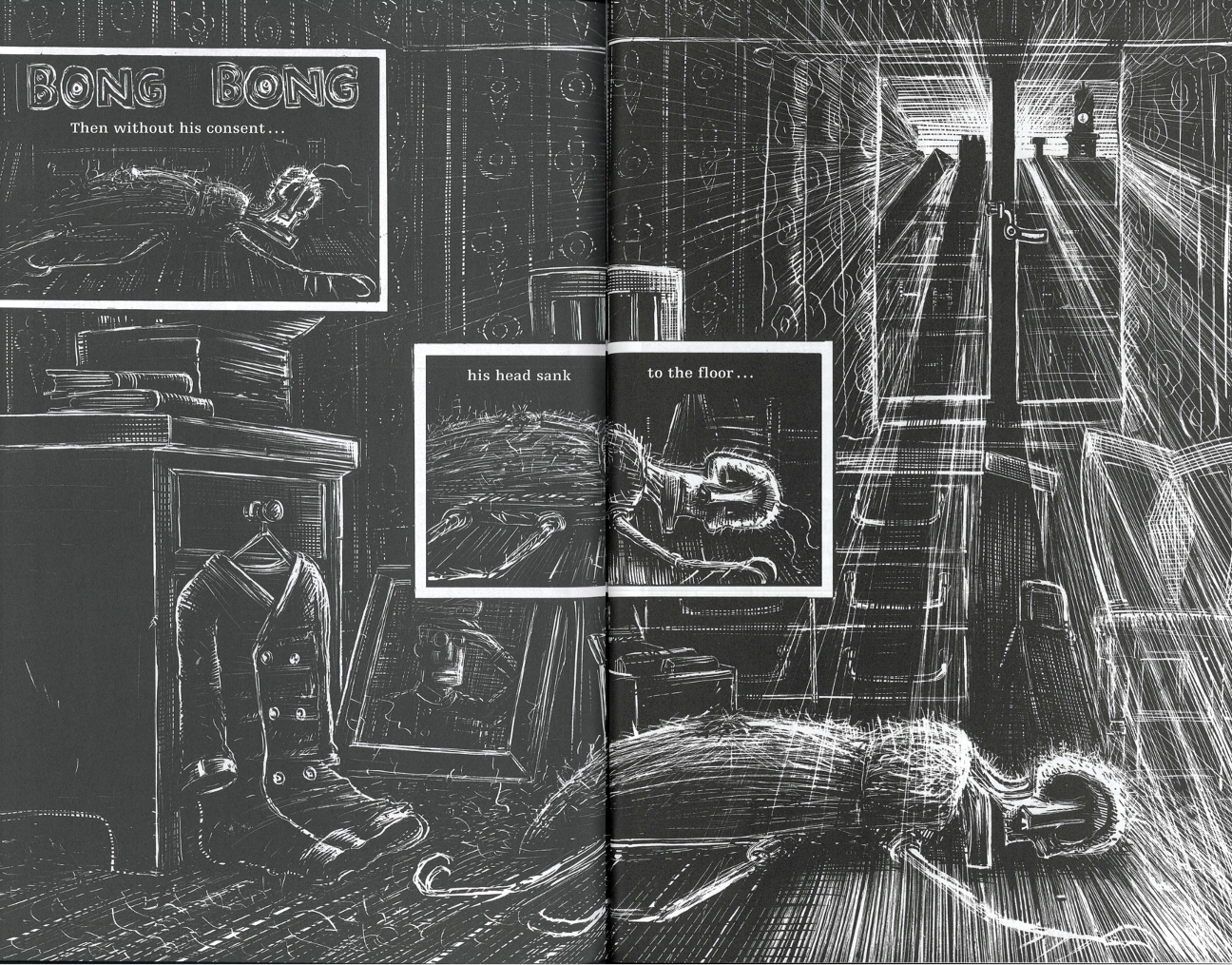
When Gregor’s head, of its own accord, sinks to the floor, the artist chose to depict it as an apotheosis of some kind, with the window bursting with angelic light behind Gregor. It’s very beautiful, in its way. It makes me reconsider my previous definition of a tragic hero having to be partly responsible for his or her fall. Gregor seems noble (and thus tragic) in his victimhood.
Of course, it is all a horrible joke. If Gregor is a martyr, he is a martyr to capitalism and its cruelties along with a martyr to his family. He suffers, but his suffering means nothing to anyone. He dies “for” his family, but there is no saving, no redemption, no resurrection. He dies alone, and his death is meaningless (maybe similar to watching a dog get run over). Gregor’s never even given a funeral. His body (was it his body??) is literally thrown out with the trash by the charwoman.
So I’m left with the question I began with: Is Gregor a tragic or pathetic figure? Or are these two ideas not as distinct as I’m making them? A tragic figure is definitely pathetic (that is—the figure evokes powerful emotion), but not all pathetic figures are tragic. Or am I wrong about that too? I thought a 100% victim character is merely pathetic, not tragic—but Kafka seems to have found a way to do both. A 100% pathetic figure—so long as they do not have a victimhood mindset—can be tragic as well. If so, bravo, maestro.
[1] For some reason, I’ve picked up the habit of saying “Tragedy tells the truth” over the years.
[2] English teachers gravitate to texts for different reasons in the classroom, but I definitely always want to teach texts that “lead to good discussions.”
[3] Gender matters a great deal too. Oedipus and Anna Karenina are both tragic, but not entirely in the same way.
[4] And, of course, there is MUCH more to say about Miller’s success or failure at grafting the ancient genre of tragedy to modern mid-century America: whether or not Willy can be tragic when he is an every day middle-man and not someone “high up” who cal fall, etc.
[5] I do not like this part of myself. But Willy does indeed fill me with “pity and fear” as an American father.
[7] It is true that some of my students have “blamed” Gregor or found him culpable for becoming a bug. We talk about how Gregor was leading “a bug’s life” even prior to his metamorphosis. The change into a beetle simply literalizes what was spiritually true of his drudgery-filled life. Some students even blamed Gregor for just working a debt-paying day job and not having more ambition, or blamed him for not seeking a cure to his bugness. All I can say is that sometimes we are very, very American—and I don’t know that being American is helpful for reading Kafka at all. I don’t blame Gregor for any of those things. He is, as I said often in class, a “beautiful soul”—mostly meaning “generous, kind, and tender-hearted.” That beauty is part of what makes everything about the book so painful and horrible.
[8] Such as in Part 1 when his jaws “snap” at the coffee his mother spills—and everyone thinks, “the bug is attacking!” when Gregor’s jaws were behaving that way instinctually. (shudder)
[9] In both Parts 1 and 2, Gregor is forced back into his room. In Part 1, his father kicks him in the room, scraping Gregor’s side, because Gregor is too wide to fit through the door. In Part 2, his father throws apples at him until one penetrates his back and Gregor gets back in the room. Only in Part 3 does Gregor voluntarily choose to go back to his room, and no one has to force him to do so.
[10] Bugs don’t have nostrils. Weird.
[11] Willy Loman definitely lacks this sudden self-awareness turn. Like Gatbsy, he dies in his illusions about himself, about the world, about his past.
[12] For some reason, I’m convinced you cannot be tragic if you have a “victimhood mindset” which (to me) basically means you are filled with self-pity, demand pity and privilege from everyone else, and generally center yourself above all others. Gregor does none of these things. He only cares about his family and dies thinking tender and loving thoughts about them. L
[13] And although Kafka was a (non-practicing, non-believing) Jew, it is a fact that The Metamorphosis covers the time period from Christmas to Easter (when Gregor dies).