Nadirs and Zeniths
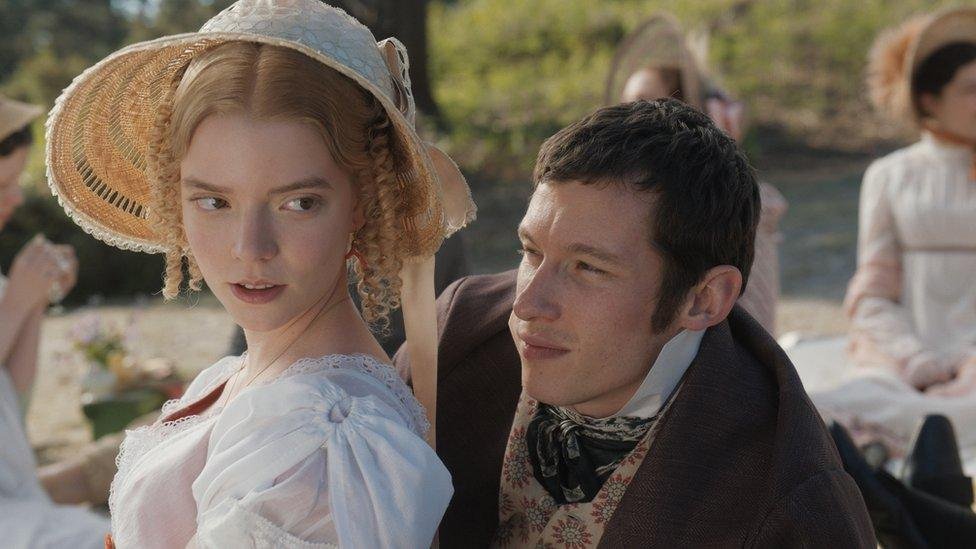
Emma, goaded on by Frank Churchill, prepares a cruel remark for Miss Bates
Generally, students find everything we English teachers assign to read boring. And it sort of is—I mean, public school teachers often don’t get to choose what texts they teach (“what is taught” is often “what books are in the back closet or shelves”—or the department, school board, or state course of study mandates certain texts), and any public school teacher who would like to stay a public school teacher must choose works that are “safe,” that don’t push the envelope too much or will upset parents or students with their content. Plus, the English teacher has assigned the work and literally sucked all the fun out of it. As the joke from 30 Rock goes: “Ain’t no reading like an English class reading ‘cause an English class reading is MANDATORY.”
Reading a novel (like Austen’s Emma) feels like an endless trudge of “nothing much happening.” Every reading seems the same. Of course, this is not true. It just takes work (passion and enthusiasm and a few tricks) to make it not true.
When it comes to teaching a “Major Work” (a novel, a play, something long enough to take several class days to teach), I’ve found that helping students sense “the shape” of the major work helps students feel like something is actually happening in a narrative.
One of the best little tricks to make a work feel forwardly propulsive (or at least—active) is identifying the high point and low point of a character’s journey in a text. And if you want to be fancy about (and I often want to be fancy), identifying the zenith (character’s best moment) and the nadir (character’s worst moment).
Which leads me back to Emma, a novel that—like all Austen novels per William Derisciewzc is simply full of chit-chat. Emma’s length and language are both great challenges to students, but if you can get them past those two obstacles, you will find (as I have) that students adore the book, are charmed by it, are turned into Austenites almost effortlessly.
The nadir of Emma’s character is super-easy to identify. It occurs when Emma makes a mildly rude comment to Miss Bates at Box Hill in front of basically every other character in the book. It is cruel, hurtful, humiliating to Miss Bates, and—in our parlance—punching down. And Mr. Knightley is right to call Emma out on it: “Badly done, Emma!”
In Hamlet, the nadir for the Prince of Denmark (in my opinion) occurs in Act 3 when Hamlet is leaving harassing Rosencrantz and Guildenstern after the play-in-a-play and going to his mother’s bedchamber (or “closet”). On his way to the Queen’s bedchamber, Hamlet passes King Claudius on his knees praying for forgiveness (or, more accurately, “not-praying). Hamlet has the perfect chance to kill Claudius and wreak his revenge, but choose not to kill the corrupt usurper. Why? Because Hamlet thinks Claudius is cleansing his soul—and to murder him as he is purified will send Claudius straight to heaven (which is definitely not what Hamlet’s father experienced when he died).
“Up, sword, and know thou a more horrid hent” says Hamlet. He is literally at his most Satanic at this moment because it isn’t enough to just kill Claudius’ physical life; Hamlet wants to kill his immortal soul and have Claudius burn in the lake of fire together.
It is odd to think that Hamlet, who in the great words of William Kerrigan, “pulls everyone into death” is not at his worst in Act 5 when finally killing Claudius but when Hamlet spares the King.
Identifying zeniths (high points) can be trickier. In Hamlet, Laertes’ zenith occurs when he forgives Hamlet for his own death and his father’s death, confesses to all his treachery, and asks Hamlet to forgive him. (His nadir is probably when he tells Claudius that he would cut Hamlet’s throat “i’ the church.”)
Emma doesn’t seem to have just one greatest ethical moment we can point to, but she does (post-Miss Bates humiliation) have a succession of great moments that show her owning up to her pride and trying to make what she’s done right again.
In short, helping students identify nadirs and zeniths help students feel the movement of a work, and (in my experience) generally makes them respect and enjoy a Major Work a little bit more.